
Controller handles any physical process variable

TAIE controllers
TAIE controllers


CD Automation’s TAIE controllers automatically control process variables such as temperature, pressure and flow – in fact almost any physical variable that can be represented as an analogue signal.

The TAIE controller range will accept an input from almost any type of sensor. As well as the standard on/off, PID and manual control modes to choose from, auto-tune and fuzzy logic control algorithms ensure the user has the tools to achieve optimum process performance.

Temperature is the most common variable, but the principles are equally applicable to all analogue variables. A temperature control loop for example can consist of a sensor to measure the temperature, a controller and a power regulator. The controller compares the measured temperature, referred to as the process value (PV), with the desired temperature, which is the set value (SV), and regulates the output power to make them the same. The difference between the PV and SV is called the ‘error signal’.

Most industrial processes such as plastic extrusion require stable ‘straight-line’ control of temperature. The PID control algorithm, referred to as ‘three-term’ control provides exactly that. The combined output is a function of the magnitude and duration of the error signal and the rate of change of the PV.

In temperature applications, either a thermocouple or a resistance thermometer is typically used. In large process control applications, signal conditioning is normally used to convert the sensor measurement into a 4-20mA or 0-10V DC analogue signal, as well as RS232, RS485 and TTL communications.

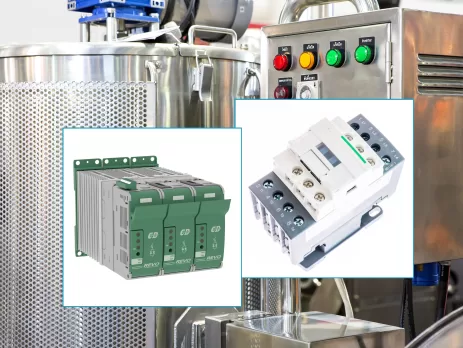
A controller requires some means of varying heating power, flow rate or pressure to the process. At the simplest level, a relay is used to operate a contactor or solenoid valve. For more sophisticated control, logic is used to switch a solid state relay (SSR) or thyristor power controller, also known as a silicon controlled rectifier (SCR). The benefits are long life, no maintenance and the ability to rapidly switch heaters which have small thermal mass.

Alternatively, analogue control is used for positioning control valves and to drive analogue input thyristors, used with time proportional on/off (burst firing) and phase angle firing for single-phase and three-phase heating applications. CD Automation’s fuzzy logic tuning algorithm handles temperature disturbances such as an oven door opening.

Auto pre-tune and manual pre-tune offer flexibility in getting the PID terms to suit the application. With up to three independent alarms and 17 different alarm types, each alarm has its own relay. An alarm inhibiting function for each alarm type prevents an alarm being triggered during start-up.

All models will accept thermocouple, RTD, DC Linear input – all with 14-bit resolution. TAIE controllers are available in eight different types and include 48 x 48mm (1/16 DIN), 48 x 96mm (1/8 DIN), 72 x 72mm and 96 x 96mm (1/4 DIN) each with a panel depth of just 80mm. They come with a five-year warranty.

Posted in Power Controllers, Temperature Controllers | Tagged , , | Leave a comment

Electric heating is cheaper and more controllable


There are several advantages of electric heating over gas. Electric heating provides much better control, particularly if using a thyristor or solid state relay (SSR). Even with a fully modulating or valve positioning burner the control swing is quite noticeable in a gas oven.

Electric heating is cheaper than gas
Electric furnace

If tight uniformity is required, then oven and furnace manufacturers would always recommend an electric oven because controlling gas burners is much more difficult. As a rough rule of thumb, we regard anything up to 800 degrees centigrade to be an oven and anything above to be a furnace for heat treatment.

In the case of a furnace, the construction changes from a steel frame with an inner skin and outer skin of sheet steel with lagging in between below 800 degrees, to a steel frame with brick work above 800 degrees. Gas heating would be impossible in a vacuum furnace where contamination needs to be avoided.

Electric heating is much more efficient. Even with the modern burners there is a certain amount of wastage for the gas supplied to the burner through pipes and suchlike, so you don’t get out all that you put into it. With electric heating, you only use the amount required.

The initial cost of the oven is lower for electric and typically a gas oven is around 20 percent more expensive. This is due to a couple of things. Firstly, the burner requires a combustion chamber of some sort. This can be either above or external to the oven chamber and ducted into the working area, or through a tube direct into the oven duct, therefore increasing the duct size along with the oven size.

Secondly, there are more safety factors to consider. By law an oven will require an explosion relief panel as well as a fresh air inlet and a volatile outlet to allow the spent combustibles to escape to atmosphere. This means fewer emissions with electric heating.

So before dismissing electric heating for ovens and furnaces as being too expensive, it pays to look at the total cost of operations, not just the unit price per kilowatt hour.

Posted in Furnaces, General, Heat treatment, Power Controllers, Temperature Controllers | Tagged , , | Leave a comment

Enhanced thyristor power control

The current range of thyristor power controllers has been enhanced


CD Automation
’s comprehensive range of thyristor power controllers has been enhanced with the addition of the REVO-Multidrive for current to 
2600A. The product is also used with complex load types where there is a need for phase angle firing. These include transformer coupled loads, fast responding loads, loads with large resistance changes and loads requiring current limiting or soft-start.

Integral feedback control regulates the power to the heating element by monitoring the line supply voltage and compensating for any fluctuations. It is a way to linearise the output power by comparing it with the input for individual phases, providing true power control, load balance monitoring, and missing or incorrect phase rotation diagnostics.

“When you start up a silicon carbide heating element for example, the initial resistance is so low that it acts almost as a short circuit, causing a huge inrush current. Typically, this would be seven or eight times the nominal current, but could be as high as 15 times the nominal current,” clarifies Jez Watson of CD Automation.

“As the temperature rises to about 500 degrees centigrade for optimal operation, the resistance of the element also increases. We are only talking about 250 milliseconds, but in that time you can do a lot of damage with high inrush current into complex heating elements such as silicon carbide or Kanthal.

“With the feedback feature on REVO-Multidrive, you can monitor the temperature at start-up and then switch to voltage control once the required operating temperature has been reached. At this point the unit automatically increases the voltage to maintain the required power.

“Feedback is often used in conjunction with phase angle firing. When using silicon carbide for example, the resistance increases with age, which affects the power output. This is because, as the elements age, their resistance increases.

“This results in decreasing current, so after say a year, the transformer voltage would need to be adjusted by changing the taps so that the resistance of the heater is at the same level. This has traditionally been provided by two or three taps on the transformer. Feedback goes some way to replace multi-tap.”

Sitting at the top of the CD Automation range, there is no load that the REVO-Multidrive can’t handle. The keypad and display allow total flexibility for the user with full configuration of the process and digital inputs, firing and control modes, to suit the application.

Real time values such as the voltage, current and power can be read from the display. Internal quick-blow fuses as standard provide complete protection for the thyristor. Additional features such as current limit, profiling, heater break alarm and RS485 communications come as standard.

Posted in Business news, Power Controllers | Tagged , , | Leave a comment

De-mystifying PID feedback loop control


If you can’t tell a PID feedback loop from spaghetti, don’t worry: you are not alone. People are mystified by the full spelling of the acronym PID, which stands for proportional integral derivative. These terms are borrowed from calculus so it is little wonder that people are frightened at the thought of grappling with the complexities of feedback control.

PID feedback loop or spaghetti?

Therefore I will start by telling you that if you were to call a PID loop a compensator instead, nobody apart from the most pedantic academic could take issue with you. OK, some engineers can get quite technical and start talking about lead-lag compensation and suchlike, but the principle is the same.

A PID controller examines signals from sensors placed in a process, called feedback signals. When a feedback signal is received, it is compared with the desired value, or setpoint, and a calculation is made of what the necessary response is in order to make the feedback signal, also known as the ‘error’ signal because of its deviation from the setpoint, match the setpoint.

The ‘official’ PID explanation goes something like this:

  • ‘P’ stands for proportional and is the factor which determines the basic rate of change at the output in response to changes in the input.
  • This proportional element is modified by the ‘I’ which stands for integral and is based on the time that a difference between setpoint and process variable exists.
  • Finally, the ‘D’ is the derivative, a function of the rate of change whilst the process variable is moving with respect to the setpoint.

Proportional control varies the amount of power supplied to the heating elements in direct proportion to the difference (the error) between the actual process temperature value and the required set value or set-point. The integral function prevents the initial overshoot on power-up, whilst the derivative function eliminates the temperature instability over time once the set-point is achieved and the process is under control.

Most heating applications can be handled by proportional control only. A Proportional controller has the ability to vary its output between 0-100 percent. This enables it to continuously adjust the output so that the power input to the process is in balance with the process demand. A linear output, typically 0-10V or 4-20mA, is easily understood. As it is an analogue value, it increases in line with the power output requirements of the controller from 0-100 percent.

Give us a call and we can explain integral and derivative control in more detail too. It’s easier than messing around with spaghetti!

Posted in Business news, General, Temperature Controllers, Uncategorized | Tagged , , | Leave a comment

Online configurator helps engineers match thyristors to different machine loads


CD Automation's online configurator

CD Automation's online configurator

CD Automation‘s newly launched Application product selector effectively cross-tabulates different single and three-phase machine loads from 30A to 2700A for a comprehensive range of thyristor power controllers. The simplicity of the form presented to engineers hides the complexity of algorithms and processes, which combine to provide an optimal load configuration.

First, using drop-down menus throughout, the engineer enters his choice from the application and element type: normal resistance elements; variable resistance with temperature using elements including molybdenum, platinum, quartz lamp, and super Kanthal among others; and transformer coupled with elements from graphite through short wave infrared to inductive loading.

Next, if selecting a transformer coupled with tungsten elements for example, the engineer can select the load configuration from single, three-phase star with or without neutral, three-phase delta and three-phase open delta. The next field is for the number of phases controlled, followed by fields for ‘input-control signal’, ‘firing mode’ and ‘required current (A)’. On the above configuration, selecting three phases and DC linear will offer up a choice of three firing modes: burst firing, single cycle or phase angle.

The matching CD Automation thyristor products are then displayed below the form, and in the case of the transformer coupled with tungsten elements mentioned above, would show the REVO-E three-phase thyristor power controller up to 600A (14 current sizes available) and the Multidrive to 2700A (in 20 current sizes). The product selector is for guidance only and the engineer is encouraged to contact CD Automation to confirm this is the correct configuration.

“CD Automation’s Application Product Selector is part of the company’s broad portfolio of online information products, intended to help engineers in industries across the board make better informed choices when selecting thyristor power controllers,” explains Jez Watson of CD Automation.

“For example, there is also a section titled ‘How to size a Thyristor Power Controller’ showing a formula that provides a simple method to calculate the thyristor current for typical resistive loads. The calculated current value is then be multiplied by 1.2 for safety margin to allow for variations in supply voltage and other tolerances of the load.”

Posted in Business news, General, Sizing thyristors | Tagged , , | Leave a comment

CD Automation finds safe port on Harvington Business Park

Contact CD Automation at its news officesNavigating your way to dry land hasn’t been simple recently, because of the drastic weather conditions that have caused flooding throughout the UK. But here at CD Automation we’ve found safe harbour by moving to smart new offices, only twelve miles from our original ‘port’.

However, unlike the unfortunate folk forced to relocate due to the flooding in Exeter and the South-West, our move was a voluntary one. We decided to hoist sails and head for new, larger office space. When we found our new facility on Harvington Business Park  it was too good to resist; so we dropped anchor here.

Managing Director, Jez Watson, told this reporter that, “Moving to a modern, larger office space has enhanced our ability to service our customers, turn round projects quickly and provide the crucial design and integration advice we have become known for. We’ve now got more workshop and storage space and better facilities overall.”

The new office space will also allow us to spend more time working on innovations, such as our recently launched custom Thyristor power controllers, which allow the end user or system integrator to tailor the product to suit their own requirements. Or even our new REVO TC, which combines a temperature controller, solid state relay (SSR) thyristor, quick blow fuse protection and current monitoring – all in a compact single-loop package.

Finally, if you want to know more about our thyristor products or even just want to drop into our new offices for a chat, email jez.w@cdautomation.co.uk or give us a call on 01323 811100.

PS – As you may well know, if you are living in the South East or any other parts of the UK affected by flooding, it’s no laughing matter – despite the odd pun at the start of this Blog post. The RNLI is the lifeboat charity that saves lives at sea and also puts its boats on standby in the event of flooding, helping save lives and homes. If you want to get involved with this brilliant charity, you can find out more here.

Posted in Business news, Our lovely new office, Temperature Controllers | Tagged , , , , , , , | Leave a comment

Pimp my Thyristor: Customise our SCR’s to promote your brand

Thyristor

CD Automation's custom thyristors


Finding a competitive edge and adding value to a product is not always easy, especially in today’s tough market conditions but the new custom thyristor power controller from CD Automation may be able to do just that.

These robust and rugged thyristors are primarily intended for OEM industrial electrical heating applications and can be customised for customer specific requirements. The fully enclosed thyristor unit offers the OEM the ability to customise its appearance with colour and logo design possibilities to match existing branding. Support documentation such as operating & installation manuals can also be supplied in neutral versions.

The range comprises one, two and three phase models with currents up to 800 amps at 690Vac. Equipped with microprocessor control, these thyristors can be run as a solid state contactor, acting as an on/off switch with zero volt turn on and zero current turn off. Alternatively they may be operated as a zero cross burst firing controller with output proportional to either a 4-20mA, 0-20mA or 0-10V DC control signal. Internal semiconductor protection fuses are supplied as standard. A heater break alarm with internal current sensing is available as an option for the detection of partial or total load failure.

The custom thyristor range can also be utilised with the REVO-PC power management system. This innovative power management system synchronises multiple loads so that the supply “sees” a near constant load with near unity power factor and without peaks whilst minimising harmonics and flicker. The REVO-PC power management system also incorporates smart power limit which uses predictive algorithms to maintain total power consumption below a preset maximum, a useful feature for electricity consumers who are on a maximum demand tariff and wish to minimise their energy costs.

Posted in General, Power Controllers | Tagged , , , , | Leave a comment

REVO TC single-loop thyristor temperature controller reduces wiring and cabinet size

The REVO TC combines a temperature controller, solid state relay (SSR) thyristor, quick blow fuse protection and current monitoring – all in a compact single-loop package.

REVO TC single-loop thyristor temperature controller reduces wiring and cabinet size

REVO TC single-loop thyristor temperature controller reduces wiring and cabinet size

CD Automation’s REVO TC thyristor power controller provides an integrated control zone and boasts a space reduction of 50%, labour reduction of two hours per control zone, single-loop integrity and high reliability. The wiring and labour savings are the result of not connecting 11 wires per zone with each wire typically taking 11 minutes. Multiple loops can be provided as an option for use in larger, multi-loop systems.

There is also less risk associated with schematic reading and understanding, distance and path measuring, and wire cutting, strapping, labelling on two terminations, crimping, terminals block wiring and panel drilling.

If one zone fails, a non-technical user can repair it within minutes. The 40A solid state relay and current transformer is designed without compromise, with heatsink and thyristor junctions generously sized to guarantee long thyristor life.

“The temperature control features in the product mean that it works at low junction thyristor temperature with 20% margin on maximum temperature,” claims Jez Watson of CD Automation. “REVO TC is a combined SSR and temperature controller with four outputs and with proportional integral derivative (PID) closed loop control affording single-loop Integrity.”

Because its REVO range is designed for field-bus systems, CD Automation also offers a range of Monitouch touch panels from 5” to 15″ that can be used as a gateway between different bus systems. For example, Modbus, Profibus DP, CanOPEN, Modbus and TCP/Ethernet can all be used. Certain models also support memory cards and feature a USB port for external memory or a printer.

The REVO TC up to 40A is normally used for plastics machinery, while the REVO TC over 60A in one, two and three phase versions is normally used in furnaces. Featuring a PID temperature controller with pre-tune, self-tune and manual tune, it provides RS485 communication from 19200-57600 baud on the Modbus RTU protocol. The operator has a dual display to read PV (Process Value), set point and load current.

REVO TC is endowed with a universal input for thermocouple, resistance temperature detector (RTD) and linear signal, and has four configurable outputs: relay, SSR, 4:20mA and 0:10V. Cooling output allows for selection between water, oil or ventilation.

Posted in Power Controllers, Temperature Controllers | Tagged , , , , | Leave a comment

Specifying thyristors: David or Goliath?

In the Bible and the Koran, David and Goliath famously do battle over the Valley of Elah. The story has been used for thousands of years to symbolise the choice between using wisdom or force to achieve an objective. It’s also about size; about the little guy succeeding in the face of overwhelming odds.

Specifying thyristors

CD Automation's simple configurator helps engineers specify thyristors accurately.

In electrical and control engineering, designers are frequently faced with a similar choice when specifying products. We constantly have to decide just how big is big enough. In CD Automation’s case of course, the decision we are normally tasked with helping our customers make is about the most appropriate size of thyristor power controller for the task in hand.

So will it be a David or a Goliath for your application? How do you decide which type of thyristor power controller best suits your project? In an attempt to make things easier for our clients, CD Automation has come up with a handy calculator to help engineers accurately specify power controllers in reference to the overall energy needs of the application.

The calculator is based on a formula and a simple method of establishing the thyristor current for typical resistive loads. The calculated value of the current (I) is multiplied by 1.2 (safety margin) to allow for variations in supply voltage and other tolerances of the load. Hence, the only information required from the user is whether the application is single phase (1PH) or three phase (three or four wire load, 2PH or 3PH) – and the calculator does the rest!

After that, irrespective of whether the load is constant or variable, inductive or transformer coupled, the right thyristor power controller to meet your exact requirements can be found on the CD Automation website. Thyristor units start at 3A, with numerous sizes available up to 2600A and 690Vac.

The main benefit of the thyristor calculator is that it alleviates the risk of over specifying and thus paying too much. So if you too are wondering whether you need Goliath’s strength or just  David’s wisdom (in thyristor equivalents of course), head over to our thyristors sizing tool and try it out.

For any other information about our range, or even advice on how to best integrate the specified thyristor into your design, give CD Automation a call on +44 1323 81110.

Image courtesy of digitalart / FreeDigitalPhotos.net

Posted in General, Power Controllers | Tagged , , , , | Leave a comment

Thyristors simplify control of heating loads


CD Automation launches REVO S

CD Automation launches REVO S

CD Automation has launched a new thyristor power controller, called the REVO S, that handles heating elements for applications such as ovens and furnaces, heat treatment and a wide spectrum of electrical loads. These range from simple single-phase heaters up to complex high temperature-coefficient three phase loads. The REVO S handles current to 2.5kA and is intended for a variety of heating elements. The thyristor power controller provides competitively priced entry level control and is designed to save space and labour.

Today more than ever, engineers are designing electric process heat systems using SCR (Silicon Controlled Rectifier) power controls. The advantages of using an SCR include more precise control of the heating process, extended heater life, improved product quality at faster production speeds and reduced maintenance costs.

An SCR is a solid-state switching device that can provide fast, infinitely variable proportional control of electric power. Unlike a mechanical relay or contactor, an SCR has no mechanical parts to wear out. The SCR will not arc or be affected by dirty contacts.

“A normal resistance element that does not vary with temperature or time allows a basic type of firing – like on-off,” explained Jez Watson of CD Automation explains. “Because temperature response times are not critical, unlike pressure or flow measurement where quick reaction time is required, simple on-off firing is cheap and adequate.”

The letter ‘S’ in REVO S stands for solid state relay, which is a simple on-off type device using DC logic signals from a temperature controller or similar control mechanism. Compact and low cost, the REVO S is designed to replace contactors and is suitable for all resistive switching applications. REVO S also has time-proportioned on-off or burst firing, which is used with DC linear type signals, like 4-20mA current or 0-10V voltage. This will switch bursts off, then on for better temperature control.

The REVO S is a self-contained unit mounted on high-dissipation heat-sinks. Integral quick-blow fuse and holder can be supplied on unit sizes 30A to 40A as an option, with internal fixed fuses on 60A upwards as standard. It is ideal for normal resistance, medium and long wave IR load types.

Posted in Power Controllers | Tagged , , , , , | Leave a comment